
Overview
GridTechPedia’s methodology provides a structured, transparent, and repeatable approach for evaluating a range of grid technologies. It integrates insights from research, industry practice, and regulatory environments to support utilities, regulators, and technology developers in making confident, consistent, and well-informed decisions.
To keep the evaluation process focused and manageable, each stage of the assessment carries a defined purpose and expected outcome:
Standardized Evaluation Criteria
- Clear definitions for TRL, ARL, and CARAT terminologies and maturity levels.
- Repeatable scoring guidance for transparent cross-technology comparison.
- Initial drafting of technology write-up considering integration challenges and what distribution and transmission grid challenges this technology helps to address.
Structured Review Process
- Independent technical editing for clarity, readability, and coherence.
- Recommend additional references to establish content reliability.
- SMEs verify accuracy of the assigned TRL and confirmed correctness and completeness of technical descriptions.
Commitment to Objectivity
- Revisions and iterations as necessary, especially as technologies and use cases evolve over time.
- Industry engagement to increase awareness of the tool and maintain openness to feedback.
How GridTechPedia Evaluates Readiness
Readiness is evaluated across three pillars:
Rating Scope
The TRL and ARL ratings in this tool were assessed by considering all technologies that fit under a broad category, rather than individual technologies or products. When multiple technologies fall within a category, the rating reflects the most mature option available. For example, the topic of Composite Core Conductors covers all recent conductor innovations relating to composite core technologies. While new designs and technologies are constantly being developed, the ratings provided by this tool are reflective of the most mature option available.
To build a complete picture, the methodology begins with technical maturity and progresses through adoption readiness, commercial readiness, and cross-cutting system context. While adoption readiness is evaluated using the CARAT tool, our application of the CARAT tool uses a modified approach that avoids assigning numerical levels to each category. This allows the review process to remain more robust and flexible over time. The following sections walk through each pillar in turn, starting with Technology Readiness Level.
TRL
Technology Readiness Level
TRL describes how mature a technology is from a technical standpoint, focusing on the development path from concept to fully proven deployment.
This standard nine level scale is used across DOE, NASA, DoD, and National Laboratories to track progress in functionality, engineering refinement, testing, and field performance.
TRL identifies remaining technical risks, highlights necessary engineering steps, and indicates when a technology becomes viable for widespread deployment. While TRL captures technical maturity, it does not address how ready the industry is to adopt a technology. For that perspective, GridTechPedia uses the ARL framework.
Key Aspects
Scientific validation
Captures validation of the principles supporting the technology.
Prototype development and testing
Tracks engineering refinement and testing as prototypes advance toward deployment.
Integration maturity
Reflects progress toward a fully proven technology deployment.
Operational performance
Captures demonstrated field performance in operational settings.
ARL
Adoption Readiness Level
ARL evaluates the challenges a technology is facing as it matures from early prototypes to commercialization and broad deployment.
Even highly mature technologies can experience slow adoption due to non‑technical barriers.
ARL organizes these risks into four categories (Value Proposition, Market Acceptance, Resource Maturity, and License to Operate) each of which is further broken down into the specific dimensions assessed through CARAT.
ARL clarifies whether adoption barriers stem from technical uncertainty, market structure, institutional readiness, or regulatory constraints.
Key Aspects
Stakeholder confidence
Reflects the market acceptance and institutional readiness needed for broader deployment.
Supply chain readiness
Assesses whether supply chain and manufacturing resources can support commercialization.
Policy and regulatory alignment
Considers how policies, standards and regulatory requirements affect adoption.
System interoperability
Examines how readily the technology can work with existing systems.
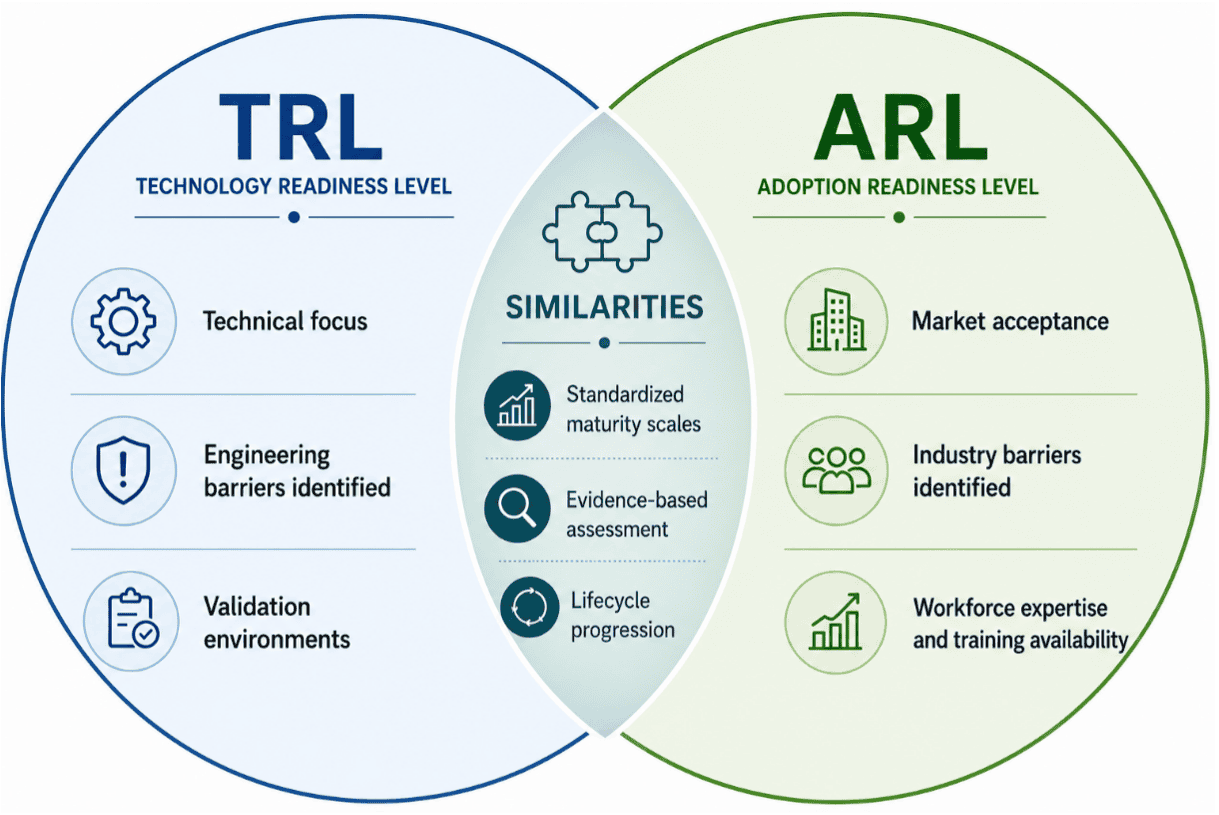
TRL+ARL
TRL and ARL Together
Individually, TRL and ARL provide valuable insight, but their real strength comes from considering them together. Together, TRL and ARL present a more comprehensive picture of the challenges a technology is facing and the barriers that may be preventing it from being broadly deployed.
Can the technology technically do what it is supposed to do?
Is the industry ready and able to adopt it?
Some technologies may be mature with high TRLs, but regulatory or economic challenges may inhibit their adoption, yielding low ARLs. Other technologies may still be in development with low TRLs but have an easy pathway into established markets, giving them high ARLs. Considering both technical and non-technical risks simultaneously can help potential users better understand the state of these technologies.
Both dimensions are essential for understanding deployment risk, investment timing, and potential impacts on grid planning.
CARAT
The CARAT Rubric
CARAT is the mechanism used to operationalize ARL scoring. The CARAT rubric is a multidimensional evaluation framework designed to anchor assessments in real-world operational needs.
DOE’s Office of Technology Commercialization created the Commercial Adoption Readiness Assessment Tool (CARAT) to assist with the designation of ARLs. The tool provides a structured framework to assess risks across 17 dimensions with definitions for what constitutes as low, medium, or high risk in each dimension. GridTechPedia assessments use CARAT iteratively throughout the evaluation process—not only at the final scoring step.
This iterative approach elevates reliability and reduces the potential for bias. Beyond scoring maturity and adoption, GridTechPedia aligns each technology with defined grid challenge categories.
CARAT Evaluation
Defined risk characteristics
Anchors judgments to predefined characteristics for low, medium or high risk.
Objective comparison
Improves objectivity and consistency across different technologies.
Early gap identification
Reveals missing test results, undefined use cases and other data gaps early.
Industry and grid alignment
Keeps assessments aligned with current industry practices and evolving grid challenges.
Integration with Grid Challenges
GridTechPedia organizes where modern technologies can most meaningfully support the distribution and transmission grid by clearly defining grid challenge categories. This established structure provides a common lens for evaluating how each technology addresses system challenges.
Each technology is aligned with GridTechPedia’s defined challenge categories, ensuring a consistent evaluation of:
Grid problem
Which grid problem(s) the technology addresses
Challenge context
The severity and context of those challenges
Technology response
How the technology mitigates reliability, resilience, flexibility, affordability or security needs
Grid Challenge categories
Aligning technologies with consistent grid challenge categories creates a common language across GridTechPedia and helps users quickly understand system-level impacts. For more information about each challenge, select a tile below to go directly to its section on the Challenges page.
Making Consistent Evaluations
GridTechPedia uses shared guardrails and industry engagement to keep all three evaluation frameworks consistent.
Guardrails for Consistency
To ensure technologies are evaluated with uniform rigor, the GridTechPedia team established a clear set of procedural and analytical guardrails. These guardrails ensure that maturity scores, adoption insights, and CARAT evaluations remain objective, defensible, and reproducible across all technologies.
This rigor is put into practice through external SME reviewers and direct engagement with the industry GridTechPedia serves. Additionally, several underlying assumptions shape how these safeguards are interpreted and applied in practice.
Category independence is not assumed
CARAT’s 17 dimensions are treated as related but non-additive. A technology’s risk profile in one dimension can influence its trajectory in another and reviewers are expected to consider these relationships qualitatively.
Most mature representative technology
TRL ratings reflect the most mature technology within a broader category. Assumptions about maturity and adoption readiness are made at the category level, not for every individual product or vendor implementation.
Comparative baseline
Where relevant, a technology is assessed relative to the incumbent technology or approach it would most likely displace, since adoption risk is often driven by switching costs and comparative performance rather than the technology’s merits in isolation.
Static snapshot in a moving landscape
Ratings reflect a point-in-time assessment. This methodology assumed periodic re-evaluation is necessary as technologies mature, relationships shift, and new entrants emerge within a category.
Data availability varies by technology
Assessments assume that publicly available data, vendor-provided data, and SME input are reasonably representative of a technology’s true maturity and adoption status, even when direct field data is limited.
Application Through Industry Engagement
GridTechPedia has conducted extensive listening sessions with a diverse range of stakeholders – including IOUs, municipal/cooperative utilities, regulators, OEMs, solution vendors, and industry organizations. These sessions revealed strong interest in the following content:
Technology descriptions
Clear explanations of technology benefits and use cases for utilities and regulators.
Cost and performance
Cost considerations, performance benchmarks and risk mitigation insights.
Technology interdependencies
More specific information about dependencies and interdependencies across technologies.
Implementation case studies
Stronger examples that include vendor references and implementation steps.
These engagements surface real-world perspectives on adoption barriers that strengthen the qualitative context behind ARL assessments and complement CARAT’s structured scoring process.
To broaden awareness and maintain alignment with national priorities, the GridTechPedia team has also presented to the NARUC Electricity Committee, the IEEE Intelligent Grid and Emerging Technologies Committee, and other national audiences. Feedback from technical and regulatory stakeholders helps keep the platform aligned with ongoing discussions about grid modernization, reliability, flexibility and emerging technologies.
A Methodology Designed to Evolve
GridTechPedia provides a consistent way to evaluate not only whether a technology works, but whether it can be adopted and applied to real-world grid challenges. As technologies and industry needs evolve, continued review and stakeholder input will help keep these assessments relevant, transparent and useful.