
Advances in High-Voltage Direct Current (HVDC)
June 2026
5 / 9
Overview
High-Voltage Direct Current (HVDC) is a power transmission system technology that converts alternating current (AC) to direct current (DC) to enable controllable and high capacity power transfer typically using power electronic converters. HVDC can efficiently transfer large amounts of power over long distances via overhead transmission lines, underground cable or submarine cable, including between asynchronous grid regions.
Two converter switching technologies are in commercial use: Line-Commutated Converters (LCC) and Voltage-Sourced Converter (VSC). LCC converter valves rely on thyristor switching devices to perform the AC-DC and DC-AC conversion and have been the dominant technology for large-capacity links since the 1950s. VSC, rely on high-power transistor technologies such as insulated-gate bipolar transistors (IGBTs) to perform the conversions and commonly implement a modular multilevel converter (MMC) topology for all new projects due to their superior performance, controllability, independent active and reactive power regulation, and compatibility with weak or passive AC networks. The U.S. Department of Energy (DOE) Office of Electricity identifies VSC as the technology type on which federal R&D investment is now concentrated[1].
The U.S. HVDC infrastructure is minimal relative to the total transmission network. National studies reference more than 640,000 miles of U.S. transmission lines, meaning that the approximately 2,370 miles of HVDC represent only about 0.4% of the total system[2][3]. Domestically, HVDC infrastructure consists of four overhead transmission lines built between 1970 and 1986, three short underwater cables commissioned between 2002 and 2010, and seven back-to-back (B2B) AC-HVDC-AC converter stations along the Eastern-Western- the Electric Reliability Council of Texas (ERCOT) interconnection boundaries, five built between 1977 and 1988 and two added in 2003–2005[4].
Benefits
Long-Distance Transmission Capacity Constraints and Energy Losses
The U.S. transmission system is under increasing strain from growing electricity demand, accelerating electrification, and rapid growth in data-center load. The 2024 National Transmission Planning (NTP) Study, led by DOE in partnership with the National Laboratory of the Rockies (NLR) and.Pacific Northwest National Laboratory (PNNL), finds that the contiguous U.S. transmission system will need to expand to 2.4–3.5 times its 2020 size by 2050 to meet projected power system demands[5].
HVDC lines transmit large amounts of power using conductors of similar physical size and similar voltage classes to high-voltage AC lines (for example, ±525 kV DC compared with 500-765 kV AC). Because DC current flow avoids inductive losses, HVDC lines experience lower electrical losses than comparable HVAC lines. For long-distance corridors, such as interregional generation hubs connecting resource-rich areas to major load centers, NLR estimates that HVDC can reduce energy losses by as much as 50% compared to equivalent HVAC transmission. HVDC becomes more cost-effective than HVAC for transferring large power blocks (generally 2,000–5,000 MW or more) over distances greater than roughly 500 kilometers (310 miles) for overhead lines. The 2024 NTP Study finds that accelerating transmission expansion, including HVDC, can significantly reduce U.S. electric system costs through 2050, with every dollar invested in transmission yielding substantial system-wide savings. Specifically, the NTP Study finds that “the use of HVDC transmission technologies, including advanced multiterminal converters, results in the greatest benefits to consumers across the transmission options studied.”[5] However, despite the advantages of multiterminal DC systems, broader deployment remains constrained by the limited commercial availability of technically mature HVDC circuit breaker.
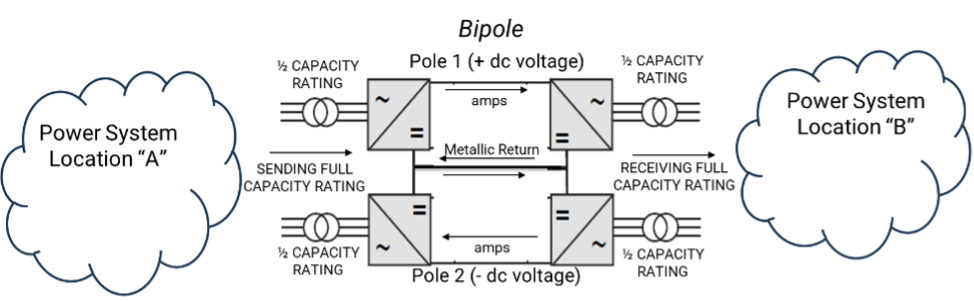
HVDC lines, at a minimum, require only two conductors compared to the three required for HVAC transmission carrying the same power, meaning the supporting towers are narrower and right-of-way requirements are lower for the same power capacity[6]. In typical higher-capacity HVDC designs, a dedicated metallic return is also included, allowing the system to maintain roughly half of its transfer capability when one pole is out of service. This avoids dependence on ground return paths, which can be technically challenging and may not be feasible in all terrains.
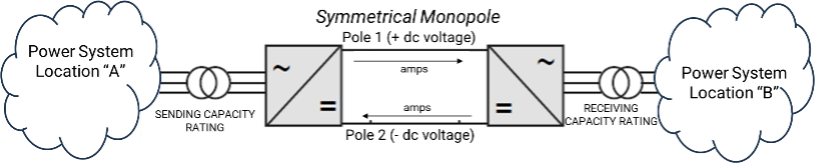
Two of the most common HVDC system configurations are shown in Figure 1 and 2 below. The symmetrical is commonly applied in many cable projects and Figure 2 is often applied in large overhead transmission projects. A back-to-back HVDC system discussed below is configured similar to Figure 1 with only bus work connecting the two converters (i.e., no transmission line).
Asynchronous Interconnection: The “Seams” Problem
The contiguous United States operates three separate synchronous interconnections that operate asynchronously to one another: the Eastern Interconnection, the Western Interconnection, and ERCOT. Power transfers between these interconnections are technically constrained because AC systems must operate at the same frequency and phase to exchange power directly. HVDC is the principal technology enabling meaningful power transfer across these “seams,” as it decouples the frequencies on each side of the link[1]. The existing seven B2B HVDC converter stations along the Eastern–Western-ERCOT boundary represents the primary mechanism for cross-seam transfers today[4].
The NTP Study modeled scenarios that explicitly allow cross-seam HVDC connections and found that interregional transmission investments, particularly those connecting the three interconnections, produce substantial system-wide benefits. When power system regions coordinate using both existing and new interregional transmission to meet resource adequacy, system costs through 2050 are lowered by $170- 380 billion. The study identifies “High Opportunity Transmission” (HOT) interfaces, candidate corridors for interregional investment concentrated primarily in the central portion of the country[5]. Interregional transmission under extreme event conditions allows power transfer support from an unaffected region to an affected region. While the actual interregional seam crossing applies HVDC, high capacity transmission such as 765 kV AC can be applied within a given region delivering an efficient and flexibility multi-dimensional approach with both HV AC and HVDC.PNNL and ORNL modeling under DOE’s Grid Modernization Laboratory Consortium demonstrated that connecting the three asynchronous U.S. interconnections via a multi-terminal DC (MTDC) system using fast MMC-DC controls can yield up to a 45% improvement in cross-interconnection frequency response, providing reliability benefits that are not achievable with existing B2B AC-constrained seam management[7].
Integration of Remote and Variable Domestic Energy Resources
The most abundant and lowest-cost wind and solar resources in the United States are located far from major load centers. This geographic mismatch between resource quality and demand is a fundamental driver of the need for long-distance HVDC transmission. DOE’s Office of Electricity identifies HVDC’s ability to connect geographically diverse variable domestic energy resources that are far from load centers as a primary grid benefit[1].
Although offshore wind development continues to advance, many projects are currently facing significant headwinds. At the transmission level, HVDC is the cost-effective solution for transporting power from offshore generation to onshore grids, particularly over long distances where submarine HVAC cables become impractical due to reactive power constraints[4][8]. DOE’s Critical Minerals and Energy Innovation Office, previously the Wind Energy Technologies Office (WETO), co-funds HVDC R&D to enable future offshore wind integration.
The NTP Study’s multiterminal HVDC (MT-HVDC) scenarios produce the highest gross benefits among all transmission frameworks modeled, primarily through improved sharing of geographically independent resources across regions. The study found that constraining transmission growth results in higher-cost portfolios requiring more nuclear generation, hydrogen, and carbon capture capacity to meet emissions targets[5][6].
Technology Readiness Level (TRL)
- High-fidelity system configuration
- Tested in relevant (simulated) environment
- Components work together as system
- Close to real application conditions
HVDC is assessed at TRL 5 because key components such as VSC-based inverters, hybrid configurations, and control schemes have been validated in relevant grid environments but are not yet widely demonstrated in integrated U.S. transmission settings.
Adoption Readiness Level (ARL)
Value Proposition
Delivered Cost
Low Risk
Costs can be competitive in the right conditions (especially when leveraging existing corridors and gaining capacity), but converter stations are a large and volatile cost driver and can dominate total project cost and schedule/capex uncertainty. Converter stations can account for as much as 60% of the total fixed cost of HVDC projects[9].
Functionality Performance
Low Risk
Performance upside includes higher controllability and potentially large capacity uplift, but line-performance uncertainties remain (e.g. insulation flashover in contamination, etc.)[10]. At the same time, the conversion concept is technically feasible and capable of providing major power upgrading, as supported by IEEE/ABB heritage literature. Additional power-system performance benefits can be achieved through inherent use of dynamic reactive power capacity at each terminal, along with advantages such as improved operation under low short-circuit levels and partial harmonic immunity[11].
Ease of Use/Complexity
Medium Risk
Implementing AC to DC conversion is operationally and technically complex: insulation/corona redesign, DC-specific switching/protection, and converter integration. DC insulator dimensioning, and DC corona and field effects[11]. DC OHL operation can require special converter types or fast restoration algorithm and may require DC switching with circuit breakers that are not readily available, in addition to extensive studies[12].
Market Acceptance
Demand Maturity/Market Openness
Low Risk
Utility/planner interest exists and is increasing, but adoption is gated by utility planning cycles, interconnection/grid-code compliance, and regulated procurement structures. Some markets in U.S. do not have clear rules for HVDC participation, and operators have limited experience with dispatching power transfers through HVDC (e.g., requires new operational models for congestion management). System planners have grown more interested in the prospect of converting AC transmission lines to DC[11]. In practice, HVDC facilities also sit inside formal reliability/planning frameworks (e.g., regional planning manuals).
Market Size
Low Risk
The addressable market could be large (many constrained corridors), but it is uncertain how often conversion is the best option versus alternatives (rebuild, reconductor, FACTS, new corridors, etc.). There are a number of situations in which conversion from HVAC to HVDC is likely to be the preferred strategy[13].
Downstream Value Chain
Medium Risk
The value chain exists (OEMs, EPCs, utilities/TSOs), but procurement can be bottlenecked by limited qualified suppliers and long lead items (converter equipment). National Grid’s HVDC framework illustrates structured supply-chain contracting at scale (both cables and converters)[14].
Resource Maturity
Capital Flow
Low Risk
Project Development, Integration, and Management
Medium Risk
AC to DC conversion projects are highly system- and site-specific; integration with the surrounding AC system, outage planning, protection/control, and staging adds execution risk[10]. EPRI also frames conversion as involving technical/operational/economic issues and feasibility assessments[11].
Infrastructure
Low Risk
The line corridor may be reused, but conversion still requires new converter stations, possible tower/insulator modifications, and sometimes upgrades to clearances/structures. EPRI emphasizes conversion feasibility depends on circuit specifics and includes practical implementation steps[11].
Manufacturing and Supply Chain
Low Risk
HVDC components are commercially manufactured, but grid buildouts face supply chain pressure and procurement constraints. The IEA notes supply chain pressures are hindering the development of transmission grid infrastructure[15].
Materials Sourcing
Medium Risk
AC to DC conversion relies heavily on “standard” bulk materials (steel, aluminum/copper conductors, insulation materials) plus power-electronics supply chains. While not uniquely dependent on rare earths, grid components broadly are exposed to price/supply volatility; the IEA flags rising component prices and supply-chain constraints for transmission buildout.[15].
Workforce
Medium Risk
HVDC conversion requires specialized engineering (HVDC controls/protection, insulation coordination, field/corona, commissioning). The IEA explicitly highlights the need to ensure “a skilled workforce” across the grid sector[15].
License to Operate
Regulatory Environment
Low Risk
While a regulatory framework exists through various planning standards and utility or regional requirements, the United States does not have national grid codes. Compliance and approvals remain non-trivial for large HVDC assets connected to AC grids, as HVDC systems represent some of the largest and longest-lived connections to an AC transmission system and, therefore, undergo rigorous standards and review[11].
Policy Environment
Low Risk
Policy can accelerate or slow transmission investment; current policy trends in many regions support grid expansion, but uncertainty remains (cost allocation, procurement rules, local acceptance). Transmission supply chain/workforce constraints are now policy-relevant enough for IEA to issue recommendations on procurement frameworks and planning visibility[15].
Permitting & Siting
Low Risk
Even if you reuse an existing corridor, converter station siting, modifications to towers/insulators, and public acceptance can still drive schedule risk. Permitting for hybrid AC/DC concepts tends to take almost the same amount of time as a new AC line due to public acceptance and the degree of innovation[12].
Environmental & Safety
Medium Risk
HVDC overhead lines introduce specific environmental and safety considerations, including electric fields, air ionization, audible noise and corona, and insulation contamination performance. CIGRE identifies “DC corona and field effects” as central aspects of the conversion process[11].
Community Perception
Low Risk
Even when reusing infrastructure, community concerns about “new” technology, fields/noise, and converter stations can be significant. ENTSO-E explicitly ties permitting duration to public acceptance and perceived innovation.
Case Studies & Implementation
National Grid awards HVDC supply chain framework contracts (Press release, 2025)
National Grid awarded multi-year framework contracts for HVDC cables and converter systems to secure long-lead equipment and supplier capacity for multiple confirmed and anticipated HVDC projects across the UK.
Hybrid AC/DC Overhead Lines (OHL) – ENTSO-E Technopedia (2025)
ENTSO-E documents hybrid AC/DC overhead line concepts that convert existing AC circuits to DC in stages (e.g., insulator replacement and selective tower modifications) to increase transfer capability while leveraging existing infrastructure.
https://www.entsoe.eu/technopedia/techsheets/hybrid-ac-dc-ohl/
References
- U.S. Department of Energy, Office of Electricity. Connecting the Country with HVDC. 2023.
- U.S. Department of Energy. Advanced Transmission Technologies. Washington, DC : U.S. Department of Energy, 2020.
- National Laboratory of the Rockies. National Transmission Analysis Maps Next Chapter of US Grid Evolution. [Online] National Laboratory of the Rockies, October 3, 2024. [Cited: May 22, 2026.] https://www.nlr.gov/news/feature/2024/national-transmission-planning-study.
- U.S. Department of Energy, Office of Electricity. HVDC COst REduction (CORE) Initiative. 2026.
- U.S. Department of Energy, Grid Deployment Office. The National. Washington, D.C. : U.S. Department of Energy, Transmission Planning Study.
- National Laboratory of the Rockies. On the Road to Increased Transmission: High-Voltage Direct Current. 2024.
- Makarov, Yuri V., Elizondo, Marcelo A., O’Brien, James G., et al.,. Models and methods for assessing the value of HVDC and MVDC technologies in modern power grids. s.l. : PNNL, 2017.
- National Laboratory of the Rockies. On the Road to Increased Transmission: High-Voltage Direct Current. s.l. : National Laboratory of the Rockies/NLR, 2024.
- U.S. Energy Information Administration. EIA study examines the role of high-voltage power lines in integrating renewables. s.l. : Energy Information Administration, 2018.
- HVDC conversion of HVAC lines to provide substantial power upgrading. Clerici, A, Paris, L, & Danfors, P. 1991, IEEE Transactions on Power Delivery, Vol. 6:1.
- CIGRE. Guide to the conversion of existing AC lines to DC operation. s.l. : CIGRE, 2014.
- Technopedia, ENTSO-E. Hybrid AC/DC Overhead Lines (OHL). [Online] ENTSO-E, 2025. https://www.entsoe.eu/technopedia/techsheets/hybrid-ac-dc-ohl/.
- Converting existing transmission corridors to HVDC is an overlooked option for increasing transmission capacity. Reeda, L., Morgana, M., Vaishnav, P., Armanios, D. 2019, Proc Natl Acad Sci U S A, Vol. 116(28), pp. 13879-13884.
- National Grid. National Grid awards HVDC supply chain framework contracts. [Online] National Grid, 2025. https://www.nationalgrid.com/media-centre/press-releases/national-grid-awards-hvdc-supply-chain-framework-contracts.
- (IEA), International Energy Agency. Rising component prices and supply chain pressures are hindering the development of transmission grid infrastructure. s.l. : International Energy Agency (IEA), 2025.
If you have any updates or would like to suggest a new technology, please let us know by filling out this form.